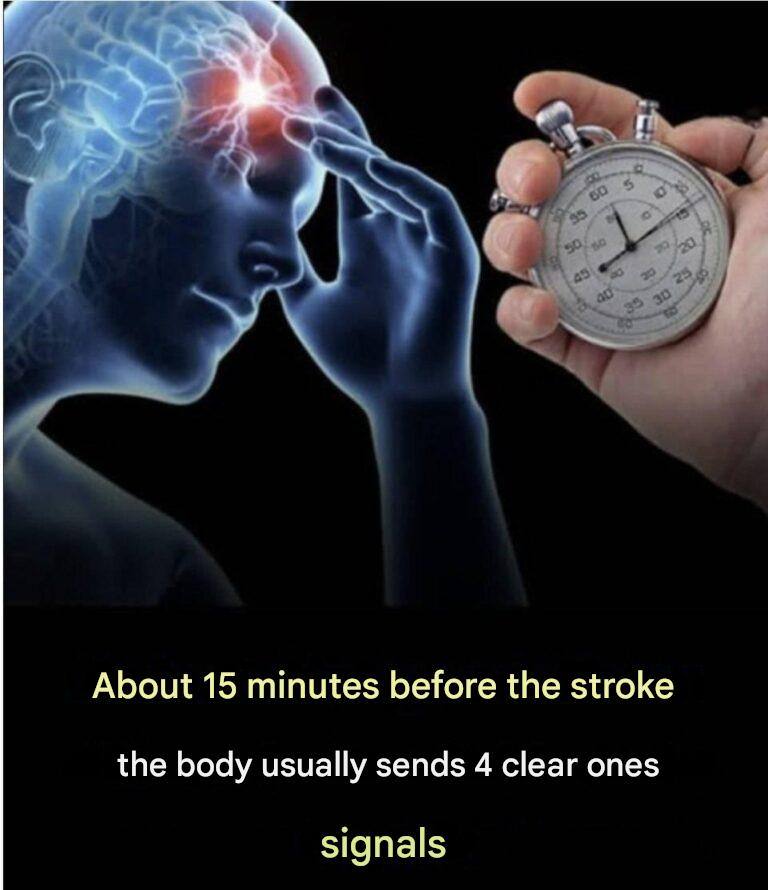
That claim is misleading and potentially dangerous.
There is no reliable set of “4 warning signs 15 minutes before a stroke” that happens for most people. Many strokes (Stroke) occur suddenly without any advance warning at all. Waiting for a specific checklist can delay life-saving treatment.
🧠 What can happen before a stroke
Some people experience a mini-stroke, called a Transient ischemic attack (TIA), minutes, hours, or even days beforehand—but:
- Not everyone has one
- Timing is unpredictable
- Symptoms are the same as a stroke, not a special “early version”
🚨 The real warning signs (use the FAST rule)
Doctors worldwide use FAST because it’s simple and reliable:
F – Face drooping
- One side of the face may sag or feel numb
A – Arm weakness
- One arm may drift down or feel weak
S – Speech difficulty
- Slurred or hard-to-understand speech
T – Time to act
- Call emergency services immediately
⚠️ Other possible stroke symptoms
- Sudden confusion
- Trouble seeing in one or both eyes
- Dizziness or loss of balance
- Severe sudden headache
⏱️ Why timing matters
Stroke treatment is time-critical:
- Brain cells begin to die within minutes
- Early treatment can prevent disability or death
Waiting for “all 4 signs” or a “15-minute window” is risky.
🧾 Bottom line
There is no guaranteed 15-minute warning with 4 signals. The safest approach is simple:
👉 If any stroke symptom appears—even briefly—treat it as an emergency.
If you want, I can explain what to do step-by-step if someone is having a stroke, or how to reduce your risk in the first place.
