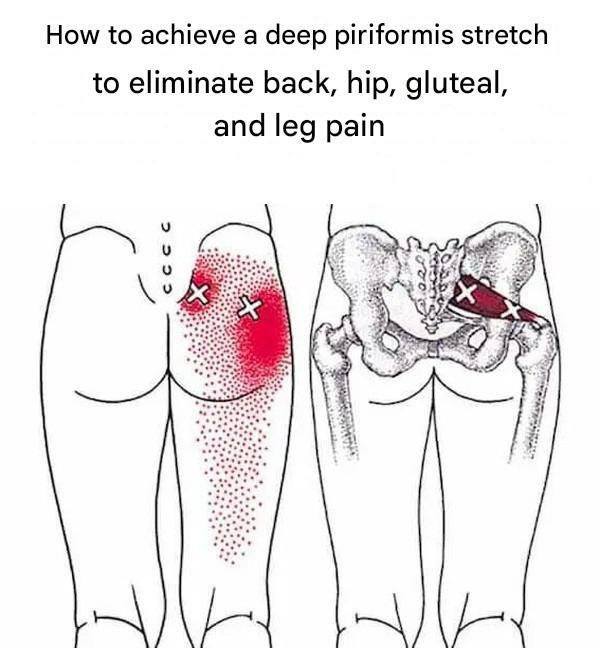
A tight or irritated piriformis muscle can contribute to pain in the lower back, deep glute, hip, and even “sciatica-like” pain down the leg because it sits close to the sciatic nerve. The goal isn’t just to “stretch harder,” but to position the hip correctly, relax surrounding muscles, and avoid irritating the nerve further.
Below are effective, deep piriformis stretch methods plus key adjustments that make them actually work.
1) Supine Figure-4 Stretch (most reliable starting point)
This is the safest and most controlled way to target the piriformis.
How to do it:
- Lie on your back with knees bent.
- Cross your right ankle over your left thigh (just above the knee).
- Keep the right foot flexed (protects the knee).
- Pull your left thigh toward your chest.
- You should feel a deep stretch in the right glute.
To deepen it safely:
- Pull the leg in gradually, not forcefully.
- Slightly shift the crossed knee outward if you feel a “pinch” in the hip.
- Hold 30–60 seconds, 2–3 rounds per side.
Common mistake: pulling the knee instead of the thigh—this reduces effectiveness.
2) Seated Figure-4 (good for tight hips during the day)
How to do it:
- Sit upright on a chair.
- Place ankle over opposite knee.
- Keep spine tall, then gently hinge forward from the hips.
- Stop when you feel a deep but tolerable stretch in the glute.
Why it helps:
This version emphasizes hip rotation + spine alignment, which often makes it more “targeted” than lying down for some people.
3) Pigeon Pose (deepest stretch, but not for everyone)
How to do it:
- From a plank or tabletop position, bring one knee forward behind your wrist.
- Extend the opposite leg straight back.
- Square hips as much as possible.
- Lower your torso gradually.
To reduce strain:
- Place a pillow under the hip of the bent leg.
- Stay upright instead of folding forward if you have back pain.
Important: If this causes sharp knee or hip pain, skip it—don’t force depth.
4) Figure-4 Against a Wall (nerve-friendly option)
- Lie on your back near a wall.
- Place foot on wall, cross ankle over opposite knee.
- Let gravity create the stretch instead of pulling.
This is especially helpful if you also have sciatic nerve sensitivity.
Key principles that make these stretches actually work
1) “Nerve pain vs muscle stretch” distinction
- If you feel burning, tingling, or electric pain, you may be irritating the sciatic nerve, not stretching muscle.
- Back off slightly and reduce intensity.
2) Don’t stretch cold
Do 3–5 minutes of light movement first:
- brisk walking
- gentle hip circles
- bodyweight squats
Warm tissue stretches deeper and safer.
3) Add activation (this is the missing piece for many people)
A tight piriformis is often weak and overworked.
Try:
- Glute bridges
- Clamshells
- Side-lying leg raises
If you only stretch without strengthening, the pain often returns.
4) Avoid aggressive twisting
Deep twisting can compress the lumbar spine and worsen symptoms if your issue is disc-related rather than muscular.
When stretching alone is NOT enough
Consider getting assessed if you have:
- pain radiating below the knee consistently
- numbness or weakness in the leg
- worsening pain when sitting
- no improvement after 2–3 weeks
These can indicate lumbar disc or nerve root involvement rather than just piriformis tightness.
Simple routine (10–12 minutes daily)
- 3 minutes walking or light movement
- Supine figure-4 stretch – 2 x 45 sec each side
- Seated figure-4 – 1–2 rounds
- Glute bridges – 2 sets of 10–15 reps
If you want, describe your exact pain pattern (where it starts, where it travels, what makes it worse), and I can help you figure out whether this is more piriformis-related or something coming from the lower spine or SI joint.
