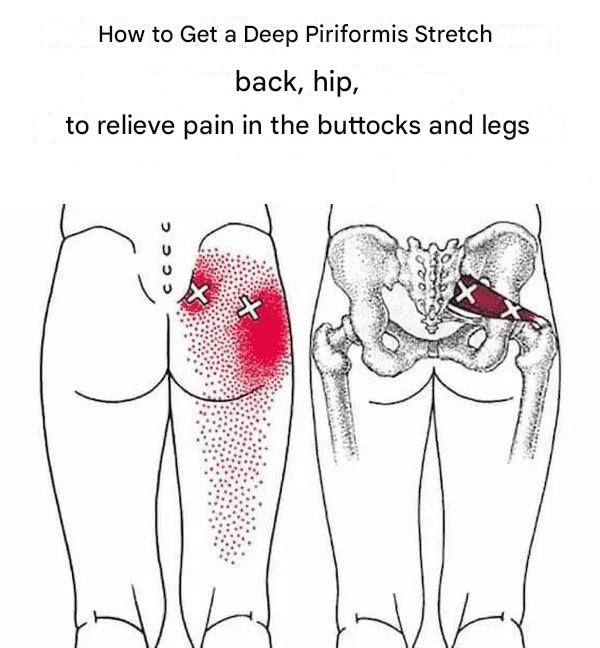
A tight piriformis muscle can irritate the sciatic nerve and contribute to pain in the lower back, hip, glutes, and even down the leg. But one important correction: stretching can often reduce symptoms, not “eliminate” all causes of pain—because similar symptoms can also come from discs, SI joint issues, or nerve compression elsewhere.
If your pain is mainly from piriformis tightness or sciatic irritation, these are some of the most effective, safe deep stretches.
1) Figure-4 Stretch (best starting point)
This is the most accessible deep piriformis stretch.
How to do it:
- Lie on your back
- Bend both knees, feet flat
- Cross right ankle over left thigh (just above the knee)
- Pull left thigh toward your chest
- Hold 30–60 seconds, then switch sides
You should feel: deep stretch in the outer hip/glute of the crossed leg.
👉 Tip: Keep your head relaxed and don’t force the pull.
2) Supine Piriformis Stretch (more direct)
A deeper variation of figure-4.
Steps:
- Lie on your back
- Cross leg as in figure-4
- Reach through and grab the back of your thigh (or shin if flexible)
- Pull gently toward chest while keeping hips level
Hold 30–60 seconds.
3) Pigeon Pose (deep yoga stretch)
More intense—don’t rush into it if you’re tight.
How:
- From a plank or tabletop position
- Bring right knee forward toward right wrist
- Extend left leg straight back
- Lower torso over front leg
Hold 20–60 seconds per side.
👉 Modification: Stay upright on hands or use a pillow under the hip.
4) Seated Piriformis Stretch (office-friendly)
Steps:
- Sit upright in a chair
- Cross right ankle over left knee
- Lean forward slightly while keeping back straight
Hold 30–60 seconds.
5) Knee-to-Opposite-Shoulder Stretch (very targeted)
How:
- Lie on your back
- Bring right knee toward chest
- Pull it diagonally toward left shoulder
You’ll feel a deep glute stretch on the right side.
Key rules to make it actually work
✔ Stretch gently, not aggressively
Over-pulling can irritate the sciatic nerve and worsen symptoms.
✔ Hold longer, not harder
30–60 seconds per stretch works better than bouncing or forcing.
✔ Do both sides
Even if only one side hurts—imbalances matter.
✔ Pair with movement
Add walking or light activity daily. Piriformis pain often improves more with movement than stretching alone.
When stretching is NOT enough
If you notice:
- sharp shooting pain below the knee
- numbness or tingling that worsens
- weakness in the leg
- pain not improving after 1–2 weeks
…it may not be just piriformis tightness. Conditions like lumbar disc irritation or true sciatica need proper assessment.
If you want, I can build you a 10-minute daily routine (stretch + strengthening) that targets piriformis syndrome and helps stop the pain from coming back rather than just temporarily relieving it.
