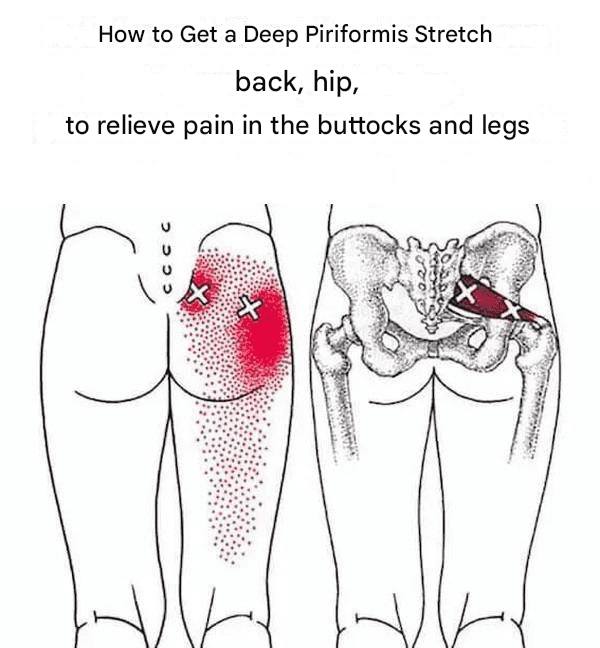
The piriformis is a small muscle deep in the buttock that can irritate the sciatic nerve when it’s tight, often contributing to pain in the lower back, hip, glutes, or even down the leg (sometimes called “piriformis syndrome”). A deep, effective stretch targets that muscle without aggravating the spine or nerve.
Below are safe, progressive ways to get a deep piriformis stretch and improve symptoms.
1. Basic Supine Piriformis Stretch (most important starting point)
This is the safest and most controlled option.
- Lie on your back with both knees bent.
- Place your right ankle over your left knee (forming a “figure 4”).
- Thread your hands behind your left thigh.
- Gently pull the left thigh toward your chest.
- Stop when you feel a deep stretch in the right buttock.
Hold: 20–40 seconds
Repeat: 2–4 times each side
Key tip: Keep your lower back relaxed on the floor—don’t arch.
2. Deep “Figure-4” Stretch (more intensity)
A slightly stronger version of the same stretch.
- From the same position, push your right knee slightly away from your body with your elbow while pulling the left leg in.
- This increases external hip rotation and deepens the stretch.
Be careful not to force it—pain should feel like a deep stretch, not sharp nerve pain.
3. Seated Piriformis Stretch
Good if you can’t lie down easily.
- Sit upright on a chair.
- Cross your right ankle over your left knee.
- Keep your back straight.
- Lean forward from your hips (not your waist).
You should feel it deep in the glutes of the crossed leg.
4. Pigeon Pose (deep yoga stretch)
This is one of the strongest piriformis stretches.
- Start in a plank or tabletop position.
- Bring your right knee forward toward your right wrist.
- Extend your left leg straight back.
- Lower your torso slowly toward the floor.
Important: Only go as low as comfortable. Use a pillow under the hip if needed.
5. Supine “Knee-to-Opposite-Shoulder” Stretch
Targets piriformis + glute complex.
- Lie on your back.
- Pull your right knee toward your left shoulder.
- Keep the opposite leg relaxed.
This often gives a very direct deep-glute stretch.
How to make the stretch actually work (this matters more than people think)
- Warm up first (walk 5–10 minutes or do light movement).
- Hold stretches long enough (at least 20–40 seconds).
- Do both sides, even if only one hurts.
- Breathe slowly into the stretch—don’t hold your breath.
- Do it daily for best results.
When pain is more than “tight muscle”
If your pain shoots sharply down the leg, includes numbness/tingling, or worsens with stretching, it may involve the sciatic nerve or lumbar spine rather than just the piriformis. In that case:
- Avoid aggressive stretching
- Focus on gentle mobility + nerve glides
- Consider a physiotherapist evaluation
What actually helps long-term (important)
Stretching alone often isn’t enough. Piriformis pain usually improves best when you combine:
- Glute strengthening (bridges, clamshells)
- Hip mobility work
- Reduced prolonged sitting
- Core stability training
If you want, tell me where your pain is strongest (low back, outer hip, deep buttock, or down the leg), and I can give you a more targeted routine that matches your exact pattern.
