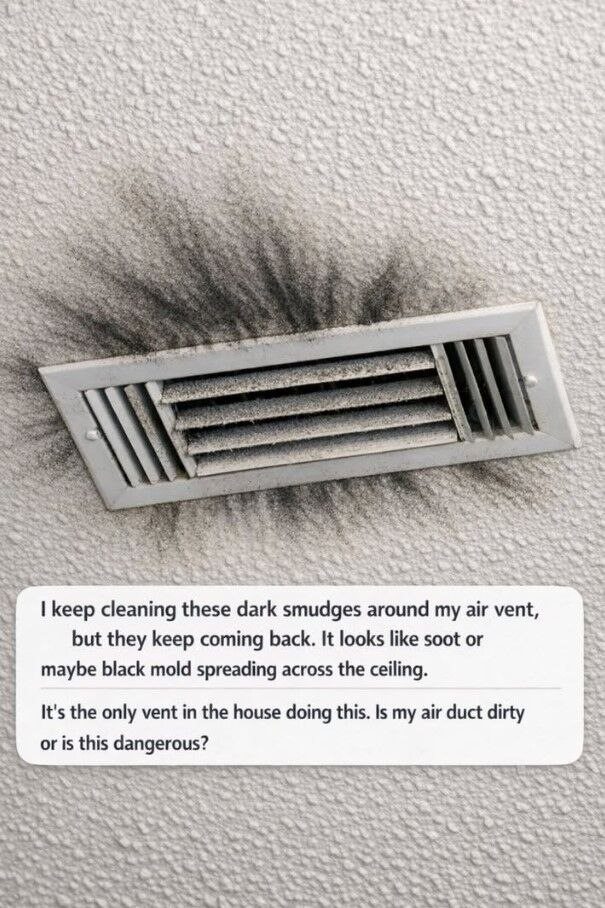
What you’re describing—dark smudges that keep reappearing around an air vent and creeping across the ceiling—is usually one of a few common things, and “black mold spreading” is only one possibility (and not the most common one).
Here are the most likely causes, in order:
1) “Ghosting” (dust sticking to airflow patterns)
This is very common around air vents.
- Air blowing from the vent carries tiny dust particles
- They stick to cooler or slightly damp ceiling surfaces
- Over time it forms dark, repeating patterns that look like soot or mold
- Even if you clean it, it returns because the airflow is still doing it
This often looks like smudges that follow air direction lines.
2) Dirty HVAC system (filters or ducts)
If the inside of your AC system is dusty:
- The vent keeps blowing fine black/gray dust
- Filters may be clogged or overdue for replacement
- Ducts may have accumulated debris
In this case, cleaning the ceiling won’t solve it until the source is cleaned.
3) Mold (possible, but usually needs moisture)
Black mold is more likely if:
- The area is slightly damp or has condensation
- There’s a leak above the ceiling or in ductwork
- The smell is musty or earthy
- The patch feels slightly fuzzy or spreads irregularly
Important distinction: mold usually grows in patches linked to moisture, not just neat airflow patterns around vents.
4) Soot or smoke residue
This happens if there is:
- Candles, incense, cooking smoke, or cigarette smoke indoors
- Poor ventilation
- AC recirculating airborne particles
The vent then “prints” the soot onto the ceiling over time.
Why it keeps coming back
Because you’re cleaning the symptom, not the source:
- If it’s airflow dust → vent system is the source
- If it’s moisture → condensation or leak is the source
- If it’s soot → indoor air pollution source is the issue
What you should do next (practical steps)
Step 1: Check your air filter
If you haven’t changed it in a while, replace it immediately. This alone fixes many cases.
Step 2: Look closely at the pattern
- Is it symmetrical around the vent? → likely dust/airflow “ghosting”
- Is it patchy and damp-looking? → possible mold/moisture
- Is it greasy/sooty? → combustion/smoke source
Step 3: Inspect for moisture
Check:
- Ceiling above vent for dampness
- Any water stains
- Condensation near duct or vent
Step 4: Clean inside the vent (not just ceiling)
If accessible, the vent grill and surrounding duct opening should be cleaned or professionally serviced.
Step 5: If it returns quickly → get HVAC checked
A technician can check:
- duct cleanliness
- insulation problems (cold air causing condensation)
- microbial growth in ducts
When to worry more
It’s worth treating as a mold issue if:
- It has a musty smell
- You see spreading irregular patches (not just vent-shaped smudges)
- Anyone in the home has allergy-like symptoms indoors
If you want, you can describe:
- what type of AC you’re using (split, central, etc.)
- whether it’s worse in summer/winter
- or send a photo description
I can help narrow it down pretty accurately.
