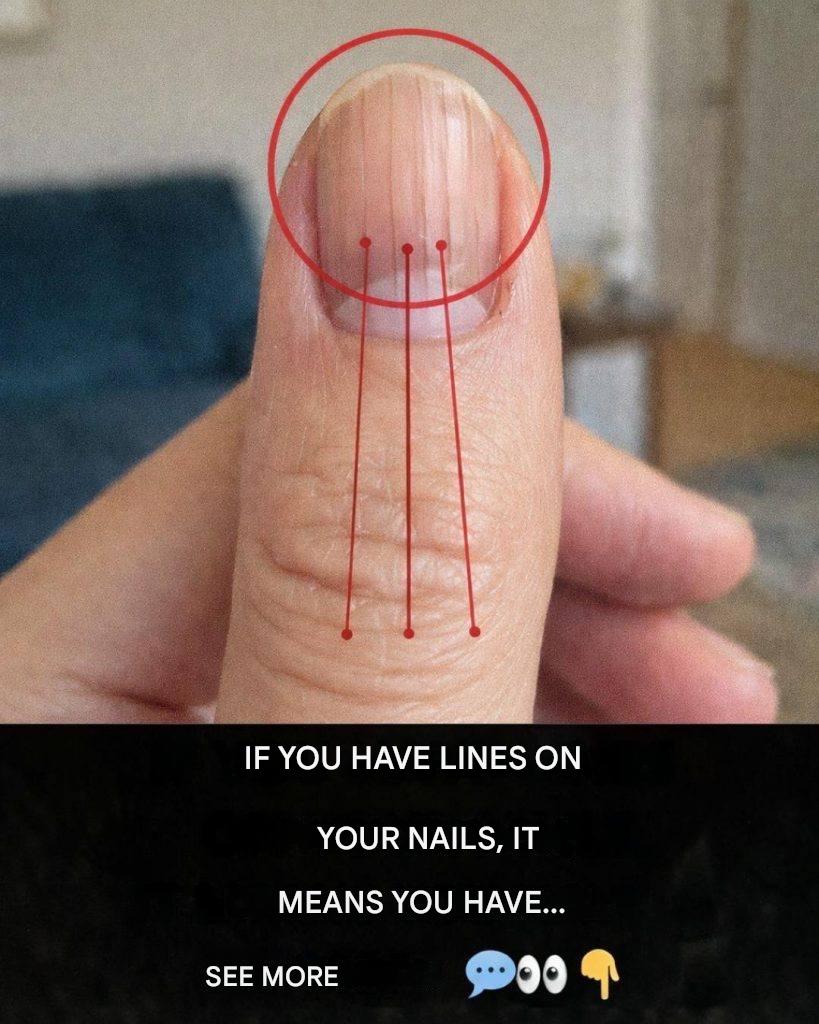
Nail lines can be completely harmless—or they can sometimes hint at changes happening elsewhere in the body. The key is the type of line, its color, and whether it changes over time.
Here’s a clear breakdown:
1) Vertical ridges (running from cuticle to tip)
These are very common.
- Often appear with age, like wrinkles in the nails
- Can also be linked to dryness or minor nutrient gaps
- Usually harmless if they’re faint and consistent
When to pay attention:
If they suddenly become deep, brittle, or paired with nail splitting, it may be worth checking nutrition (iron, B vitamins).
2) Horizontal lines (Beau’s lines)
These are deeper grooves that run across the nail.
Beau’s lines
They can appear after a period when nail growth was temporarily disrupted, such as:
- High fever or severe infection
- Major physical stress or surgery
- Uncontrolled chronic illness
They act like a “timestamp” of stress on the body—showing when growth paused.
3) Dark vertical lines (brown/black streaks)
These are more important to evaluate carefully.
They can be caused by:
- Benign pigment changes (especially in darker skin tones)
- Injury to the nail
- In some cases, something more serious like nail-related skin cancer
One condition doctors want to rule out is:
Melanoma
Red flags include:
- A single dark stripe on one nail
- The line widening over time
- Pigment spreading onto surrounding skin
- Nail deformity or bleeding
4) Pale or spoon-shaped nails with ridging
Sometimes nail changes reflect internal health issues, such as:
Iron deficiency anemia
Possible signs include:
- Brittle nails
- Pale or thin nails
- Spoon-shaped curvature (in more advanced cases)
5) Other systemic clues
Nails can sometimes reflect broader health conditions, including:
Liver disease
May be associated with:
- White nails or “Terry’s nails”
- Ridging or color changes
When nail lines are usually NOT serious
Most nail lines are harmless if:
- They’re symmetrical on multiple nails
- They’ve been present for a long time without change
- There’s no pain, bleeding, or rapid evolution
When to get checked
It’s a good idea to see a clinician if you notice:
- A new dark line on a single nail
- Rapid changes in nail shape or color
- Lines appearing after unexplained illness
- Nail changes along with fatigue, weight loss, or other symptoms
If you want, you can describe or even upload what your nail lines look like, and I can help narrow down what category they likely fall into.
