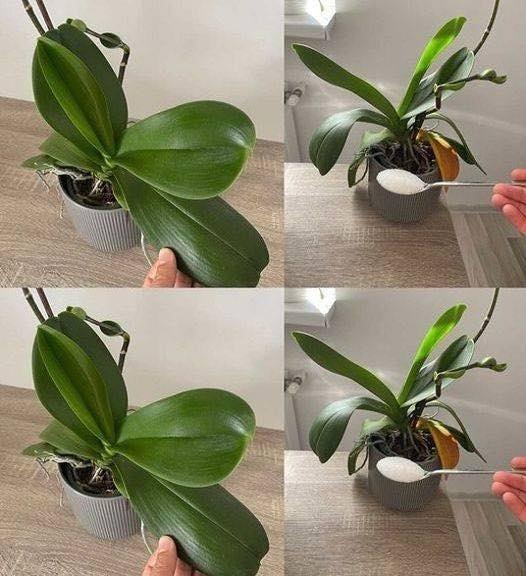
Here’s a safe, effective tip for helping orchids bloom more reliably — something many growers talk about — but with the right science behind it.
🌸 Orchids: “Just 1 tablespoon and they’ll bloom non‑stop!”
There’s a popular idea that a special fertilizer or mixture will make orchids bloom continuously with almost no effort. The truth is:
✅ Orchids can bloom more frequently and more robustly with the right feeding
❌ But there’s no magic tablespoon that makes them flower nonstop without proper care.
🌿 What Orchids Really Need to Bloom Well
Orchids are epiphytes — they usually grow on trees, not in soil — so their nutritional needs and watering patterns are different from typical houseplants.
🧪 1. A Balanced Orchid Fertilizer
To encourage strong blooming:
- Use a balanced fertilizer (e.g., 20‑20‑20) or one labeled for orchids.
- Better yet: use a formula higher in phosphorus during bloom‑inducing periods like 10‑30‑20 — phosphorus supports flower development.
- Dissolve fertilizer properly — orchids are sensitive to salt buildup.
👉 A common guideline is:
➡️ 1/4 to 1/2 teaspoon per liter (quart) of water
…applied regularly, not a full tablespoon!
🕐 Feed during the orchid’s growing season (spring–early fall).
Reduce or pause feeding in winter if growth slows.
💧 2. “Weakly, Weekly” Feeding
Instead of a big dose:
✔️ Dilute the fertilizer
✔️ Feed lightly and often
This prevents root burn and mimics how orchids receive nutrients in nature.
☀️ 3. Good Light + Temperature Cycle
For most orchids (like Phalaenopsis):
🌞 Bright, indirect light
🌡 Warmer days (~24–29 °C / 75–85 °F)
🌙 Cooler nights (~15–18 °C / 59–65 °F) — night‑day temperature difference helps trigger blooms.
💦 4. Watering Carefully
Orchids don’t like “soggy feet.”
Water when the potting mix is dry, not on a fixed schedule.
Signs it’s time to water:
🌱 Roots look silvery/white
❌ Not mushy or dark green
🪴 5. Repot at the Right Time
Orchids typically need repotting every 1–2 years in a chunky, airy medium (like bark or sphagnum), so roots stay healthy and can bloom well.
📌 So What About That “1 Tablespoon” Claim?
There isn’t a universal tablespoon‑only fertilizer trick that forces nonstop blooms by itself.
However, one popular homemade approach some growers use (sparingly!) is:
➡️ Weakly diluted fertilizer solution
…applied regularly instead of one strong dose.
But this still follows the weakly, weekly rule — not a single tablespoon dose.
🌺 Bottom Line
Orchids bloom best when you combine:
✔️ Right fertilizer (lightly diluted)
✔️ Good light and temperature range
✔️ Correct watering habits
✔️ Healthy potting medium and airflow
A tablespoon‑only “miracle” isn’t real — but a balanced feeding routine can definitely help your orchids bloom more often and more beautifully 💐
If you tell me what kind of orchid you have (e.g., Phalaenopsis, Dendrobium, Cattleya), I can give you a specific fertilizing plan for that variety!
