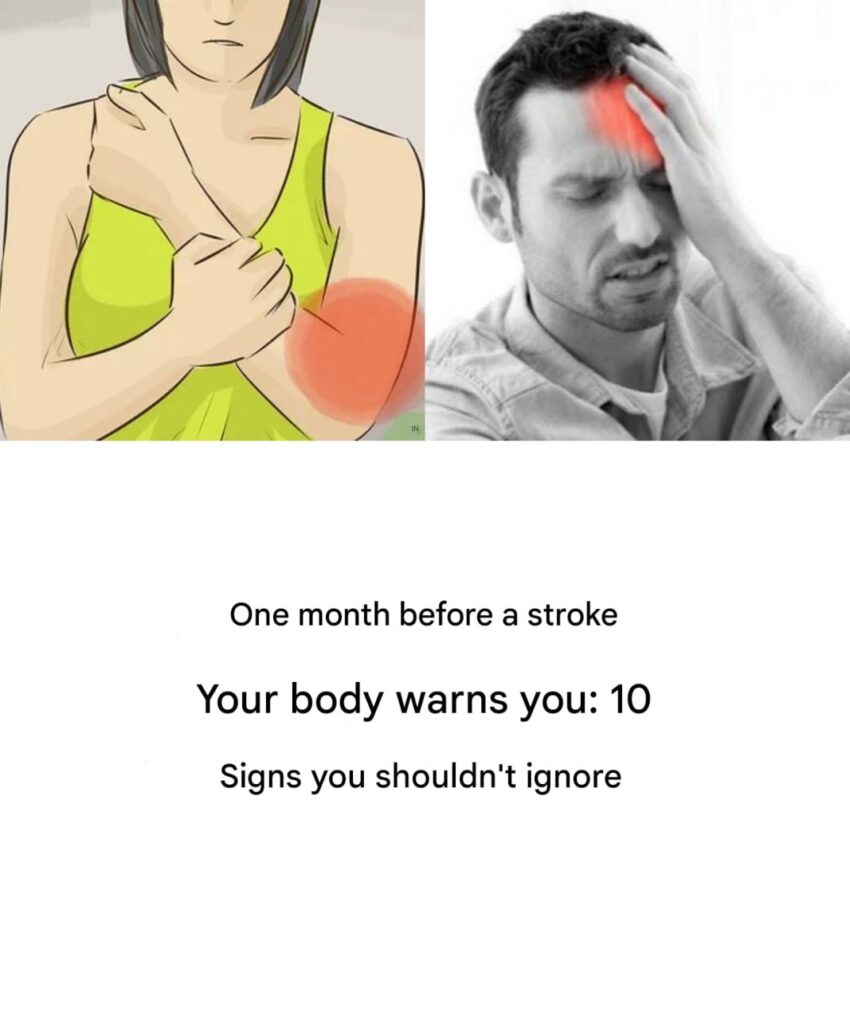
The claim that “your body warns you one month before a stroke” is a bit misleading.
A full Stroke usually happens suddenly. There is no reliable set of symptoms that consistently appears exactly one month before a stroke.
However, some people do experience warning events or risk signals in the days to weeks before, most importantly something called a transient ischemic attack (TIA)—often called a “mini-stroke.” These are short-lived and should never be ignored.
Here are 10 warning signs and risk signals that may appear before a stroke or TIA, and deserve medical attention:
1. Sudden numbness or weakness
Especially on one side of the face, arm, or leg—even if it goes away.
2. Brief speech problems
Slurred speech, trouble finding words, or confusion that resolves quickly.
3. Temporary vision loss or blurred vision
In one or both eyes, even for a few minutes.
4. Sudden dizziness or loss of balance
Especially if it comes with coordination problems or falls.
5. Severe, unusual headache
A sudden “worst headache of your life,” or a new type of intense headache.
6. Episodes of confusion
Brief periods where thinking, understanding, or awareness feels “off.”
7. Tingling or “pins and needles” sensations
Especially on one side of the body without a clear cause.
8. Transient facial drooping
One side of the face may feel weak or look uneven for a short time.
9. Brief difficulty walking
Unsteady movement, stumbling, or loss of coordination that resolves.
10. Irregular heartbeat or palpitations
Can signal underlying heart rhythm problems (like atrial fibrillation) that increase stroke risk.
Important context
- These symptoms are often linked to a Transient ischemic attack, which is a medical emergency warning sign, not a harmless episode.
- A TIA can happen days or weeks before a major stroke—or sometimes not at all—but it significantly increases risk.
When to act
If any of these symptoms occur—even if they go away within minutes—seek urgent medical care immediately. Early treatment can prevent a major stroke.
If you want, I can also explain early risk factors (like blood pressure, diabetes, stress, or cholesterol) or how to reduce stroke risk long-term.
